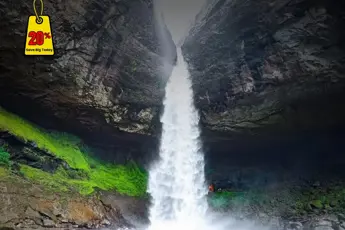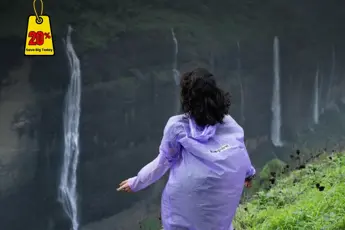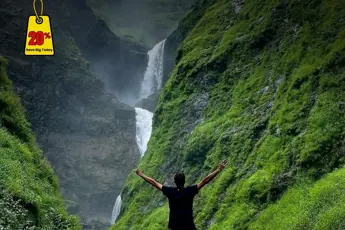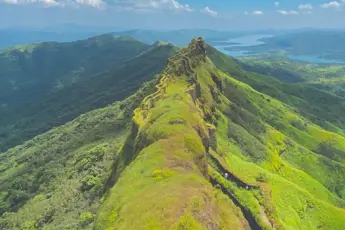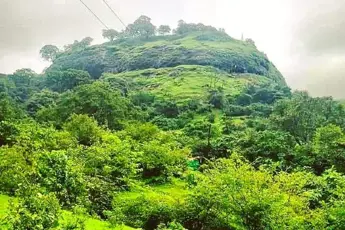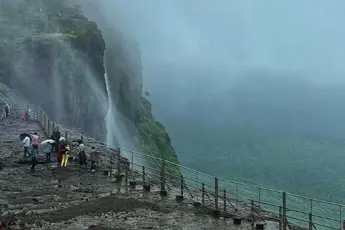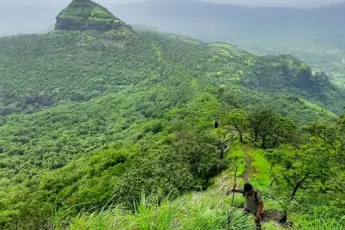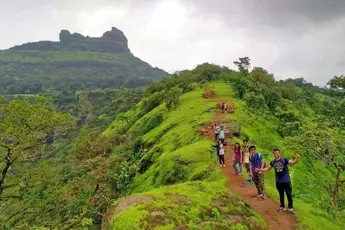


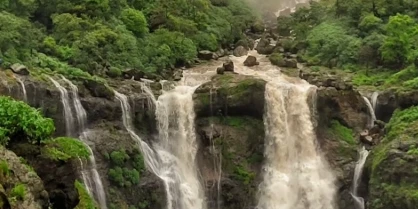
The Nanemachi Waterfall is a sight for sore eyes carved by nature into one of the mystical horrors of Majha Maharashtra. Hidden deep in the forests of Raigad district, the site has allure for various kinds of adventure seekers, trekking enthusiasts, and nature lovers due to its breathtaking beauty, pristine aura, and exciting trekking path. The waterfall gushes from an enormous height into a mesmerizing pool surrounded by blue-green foliage and towering cliffs. When you see the clear water rushing down into a naturally beguiled lay-back area, it becomes a tranquil stretch for all of them seeking peace along nature's gentle folds. In comparison to other famous waterfalls of Maharashtra, the Nanemachi Waterfall remains irregularly untouched, thus serving as a perfect hidden escape route for many wanting to shed the ordeal of big cities. By the time trekkers get to the waterfall, they will have experienced a rather adventurous route combing in and out of dense forest, rocky terrains, and muddy trails. This picturesque route provides breathtaking viewpoints to take in the earth's calmly flaunting beauty in all its raw glory. The utter Olympic cover in the woodlands is the cherry on top; birds chirping around, the freshness of the damp earth, and a cool breeze are a treat to their expedition. The Nanemachi Waterfall Trek package is ideal for travelers seeking monsoon trails and hidden waterfalls.The history and local importance of any region are firmly rooted in legacies, folklore, and cultural heritage that shape the identity of the place and its people. The stories that each village, town, or natural landmark has are such that they can be traced back to generations; they reflect the very ethos, traditions, and beliefs of the local communities. They often blend myth and reality to create mystique and lure tourists and researchers alike. Many such places are closely associated with the events and personalities from history, adding to their worth. Also, festivals, rituals, and practices of culture associated with these places remain important for the local inhabitant and connect them with their ancestry and traditions. Monsoon adventure lovers can explore more trails through our Treks in Maharashtra collection.Nearby Attractions in the Konkan RegionKonkan Region in Maharashtra is a picturesque coastline embraced by nature, framed by hills and calm beaches, ancient forts, and gracious waterfalls. Thus, nature can show off her beauty in full in this way, with the Western Ghats on one hand and the Arabian Sea on the contrary. A lot of travellers with multiple interests will be attracted to the astonishing beauty of nature, lush hills, tranquil beaches, ancient forts, and majestic waterfalls-which together create an artist's palette.Lingmala Falls: Lingmala Falls is almost a two-tier spectacle, most beautiful on the view of the waterfalls. Visiting these waterfalls while they are full during the monsoon when they get engulfed inside dengue and lush greenery is the most enjoyable experience.Dudhsagar Waterfall: Technically, Dudhsagar Waterfall is located in Goa. However, most of the tourists enjoying it come from the Konkan area. It has four steps that make this waterfall one of the highest in India and by every sight itself, it seems like a stream of flowing milk.Savdav Waterfalls: Savdav Waterfalls near Kankavli is very much an offbeat gem in the dense jungle. The cool, serene pool that nature has formed underneath the waterfall is said to soothe the senses and refresh one. Pandavkada Waterfalls: The Pandavkada Waterfall, 101 m high, is a very popular tourist spot in Navi Mumbai and is surrounded by intensely green hills. Some historical indications suggest that this place used to be visited by the Pandavas of the Mahabharata.Other Nearby Trekkable Places.Konkan is a rough and charming land, dotted with opportunities for trekking. From the verdant hills to ancient forts, these trekking sites balance two rival ends: offering adventure-seekers a challenging experience while pampering them over cool spots.Rajmachi Fort Trek: This is an extremely popular trek from Lonavala across dense forests and picturesque trails, leading to breathtaking views of the Sahyadri mountain ranges. The fort possesses a lot of historical significance - it was under the rule of the Marathas, and afterwards, the British.Kalsubai Peak Trek: The highest peak in Maharashtra at 1646 m above sea level, Kalsubai poses a test to reach the top, but those who do are rewarded with a spectacular view of the whole surrounding range of mountains and valleys. The Kalsubai temple adds a holy dimension to this peak.Trek of Harihar Fort: Hewn into stone, the very steep, exciting, and thrilling ascent leading to the Harihar Fort is one of the best treks in the Western Ghats. This great height point, which is a triangular hilltop, is scintillating with its view and its climb of the surroundings.Vasota Fort Trek: Trekking towards Vasota Fort inside Koyna Wildlife Sanctuary is filled again with unlimited charm. It offers one of the best views over adjoining forests, rivers, and valleys. Short boat rides across the Koyna backwaters are also part of this adventure.Sudhagad Fort Trek: Yet another less-traversed route, Sudhagad Fort would prove to be a pleasant diversion from Rajmachi or Lohagad which is fast filling up with trekking crowds. The sights have it: dense forest walks and spectacular views from above.Sindhudurg Fort: Today, Sindhudurg Fort stands as a sea fort on an island off the Malvan shore and was built in the 17th century by Chhatrapati Shivaji Maharaj. It served as a very important naval base for the Marathas and exhibited prowess in naval warfare.Raigad Fort: Raigad Fort has historically held much importance as it was the seat of the capital of the empire of Shivaji Maharaj. Very steep is the trek, but excellent views over the Sahyadri stand the visitor in good stead. Inside the fort, a visitor can see Raj Bhavan, the Queen's quarters, and of course, the famed Hirakani Buruj.Vijaydurg Fort: Vijaydurg Fort is another fort regarding which concern is there in terms of the Konkan. Surrounded by the Arabian Sea on three sides, it has quite an interesting history concerning naval battles and strategic importance.Ganpatipule Temple: The Ganpatipule Temple is probably the most famous in Konkan, referring to Ganesha. The most fascinating portion of this temple is that it has a naturally monolithic idol of Ganpati, over 400 years old. This gives more beauty to it with the very near Ganpatipule white sandy beach.Parashuram Temple: In Chiplun lies the temple that was dedicated to Parashuram, the sixth avatar of Lord Vishnu. Beautifully carved and decorated, this structure becomes an architectural marvel unto itself. The calm environment and greenery surrounding it allow a peaceful spiritual encounter.Keshavraj Temple: In a secret hill area near Dapoli hides Keshavraj Temple, a little-known gem of Lord Vishnu. The visit to the temple is a nice trek through thick forests and small streams emphasizing the beauty of the route thus rendering it scenic for both journey and destination alike.Modes of TransportNanemachi Waterfall can be reached using different modes of transport. Some of the transport can be used to reach here:By Road:It is the best option to arrive at Nanemachi Waterfall by travelling on the road. The area has good connectivity by state highways and national highways, thus making this place easily accessible by public and private transport.From Mumbai: Take the Mumbai–Goa Highway (NH66) and drive toward Mangaon. From Mangaon, a diversion leads towards Mahad and further smaller roads lead to Nanemachi Waterfall. Cab hiring or taking a private vehicle is the best option.From Pune: By Tamhini Ghat Road or Pune–Mumbai Expressway, travelers will be able to catch a road toward Mangaon and then finally to Mahad, before hitting Tarzan to reach Nanemachi Waterfall.From Ratnagiri: For Ratnagiri travellers, NH66 is to be tracked towards Mangaon. At this juncture, travellers can find internal roads to lead them to the waterfall. Public options will also have buses run by the state and private operators offering bus services to Mangaon or Mahad from Mumbai, Pune, and Ratnagiri. From there, local jeeps or cabs can be hired to reach the nearest drop-off point before trekking.By Rail: Mangaon Railway Station is the nearest railway station to Nanemachi Waterfall and is well-connected with Mumbai, Pune and other major cities through the Konkan Railway Network. From Mangaon, tourists can hire private taxis or local jeeps to reach the base village near Nanemachi Waterfall.From Mumbai: Numerous trains run on the Konkan Railway and stop at Mangaon. Travellers can take any of these trains like Konkan Kanya Express, Mandovi Express, etc. to reach Mangaon.From Pune: From Pune, tourists can avail of trains Pune Ernakulam Express or Pune Madgaon Express and reach Mangaon.From Ratnagiri: Railway trains from Ratnagiri to Mangaon are present in high frequency since both are very well associated along the Konkan Railway line. As soon as tourists arrive at Mangaon Railway Station, they will have to manage their arrangements for a taxi or shared jeep for the close distance towards the trekking route.Best Time to Visit Nanemachi WaterfallVisit to the waterfall is appreciated at any point between June and October and after rainfalls, during the post-monsoon season, for it is at these times that the waterfall is full of gush with flowing water, colourful greenery, and thereby an enthralling environment.During the rainy season (June-September): The rain falls so heavily during the season of the monsoons that the waterfall becomes a mesmerizing scene. The whole area looks so green and the view is stunning. The trek during this period proves challenging but rewarding to all trekkers and adventurers. However, caution should be exercised as the trails are generally extremely slippery, and the current of the river is very strong.Post Monsoon (October-November): This assures a good flow of water, still up to the grandeur of its visit. The climatic conditions are quite stable, and the lack of rain encourages trekking during October and November. The forest surrounding the area remains green and alive, contributing an excellent habitat for photography. This is the ideal time for photography and walking with nature without fear of intense rainfalls.Avoid Summer and Winter: Low water levels at the waterfall and extremely hot conditions make summer months from March to May uneventful visits. Winter (December to February) has pleasant weather, but without the sufficiency of a full-flowing, the visit does not pay off.