


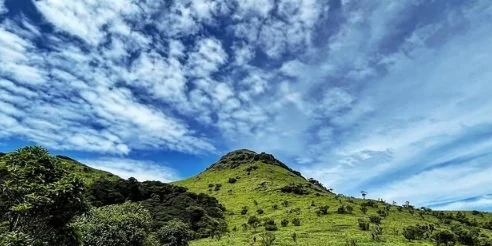
Coorg and Karnataka's third highest, the tallest among all, is the breathtaking trekkers' paradise at the Western Ghats' Tadiandamol. Reaching the height of roughly 1,748 meters (5,735 feet) or so over sea level, the lofty top remains in the range of Brahmagiri and offers a pure adrenaline rush to nature and adventure enthusiasts alike. 'Tadiandamol' is what the Kannada name signifies, i.e., 'the biggest hill,' an aptly regal moniker to place on its rising height. Situated between shola forest, rolling hills, and fog, Tadiandamol is a haven for trekkers, photographers, and nature enthusiasts to find solitude amidst nature.Untouched in its natural beauty when compared to other tourist-bitten trekking destinations, the peak has minimal disturbance from humans and enormous biodiversity. The trek features gentle slopes, rock tracks, and steep climbs, thus being equally fascinating for first-time trekkers and experienced ones. At the very beginning, the tourist is presented with a sight of the Western Ghats, clouds typically bubbling just below your feet, a fantasy-like, otherworldly experience. On a clear day, there is a sweeping panorama of coffee estates that stretch out as far as the eye can see, emerald rainforest, and surrounding hills providing an awe-inspiring view. Explore more mountain escapes through our Treks Near Bangalore guide.Why It's a Must-Visit for TrekkersIt is always one of South India's best rewarding treks. Here is how it must be on every trekker's bucket list:Scenic Beauty – Green streams, waterfalls, and copious and abundant flora and fauna surround the trek to the summit. The trail itself is as enchanting as the destination.Moderate Degree of Difficulty Tadiandamol's overall distance of around 7-8 kilometres one-way to hike is not challenging whatsoever, and it's a very appropriate option for beginners and seasoned people alike.High Biodiversity – The trek passes through the Pushpagiri Wildlife Sanctuary, where there is an immense variety of wildlife such as Malabar giant squirrels, abundant birdlife, and even elephants within the inner forest.Peaceful and Less Touristy – Unlike other busy trekking spots like Kumara Parvatha or Mullayanagiri, This hill is less touristy, and therefore a serene retreat into nature.Cultural Experience – The trekking path begins at the scenic village of Kakkabe, famous for Kodava culture, traditional-homestays, and old Nalknad Palace, giving it a cultural experience.Best Time to VisitThe best time to visit this hill depends on what kind of experience you’re looking for. Each season offers a unique charm, but the most recommended periods are post-monsoon (September to February) and winter (November to early March).Post-Monsoon (September to November): This is the ideal time for trekking to this hill. The rain in the monsoon keeps the landscape green, lush, and colourful, so the trek is simply scenic. The waterfalls and streams on the trek are full-flowing, so the trek is even more scenic. The weather is temperate and pleasant, although the trek trail is a bit slippery as it has rained recently.Winter (November to February): Clear and cold winter months are the ideal time of year for panoramic vistas. The climate ranges from 10°C to 20°C, a very agreeable trekking experience. Early morning treks in misty trails offer a mystic experience for the trek. The forest is, however, comparatively dry during the post-monsoon.Summer (March to May): Summer is not that great, but morning trekking is fine. But afterwards, the sun heats up, and the trek is tiresome. The flora dries up, and streams on the trek dehydrate, stripping the trek of its charm as such.Monsoon (June to August): Monsoon time makes this hill a whole different world. This makes the forest thicker and greener, but also hazardous to trek. Steep routes, leeches, and the resultant low visibility during fogs can disturb the trekking team. Having said this, if one loves monsoon treks and is well-dressed, then it can be highly thrilling.How to Reach TadiandamolNearest Cities and Transport OptionsIt is reasonably well linked to the major towns by train, road, and air. The nearest towns offering connectivity are:Madikeri (Coorg) – 35 kmMysore – 120 kmBangalore – 260 kmBy Road: The most direct method of going to the hill is by road. Base trek village Kakkabe is a metalled road linked and can be reached by private vehicles, taxis, and buses from Mysore, Bangalore, and Coorg. KSRTC and private bus service regular supply exists and a facility is offered for local transport from Virajpet to reach Kakkabe.By Rail: The closest railway station to the hill is Mysore Railway Station (120 km). Taxis or buses can be hired from Mysore to Virajpet or Madikeri and further extended to Kakkabe.By Airport: The closest airport is Kannur International Airport (90 km) in Kerala, and the second closest airport is Mangalore International Airport (150 km). Taxis or buses can be hired from both airports to Coorg and further extended to Kakkabe.Directions from Major CitiesFrom Bangalore: Via NH75 through Mysore and Hunsur, then SH27 to Virajpet and go on to Kakkabe.From Mysore: Via SH88 through Hunsur and Gonikoppal to Virajpet, then go on as directed to Kakkabe.From Coorg (Madikeri): Go on to Napoklu, then the Bhagamandala road to Kakkabe.Parking and AccessibilityFor car drivers to the foot of the trek, parking is available close to Nalknad Palace, the trek's starting point. The final road to the trek is a bad and narrow road, and it's therefore best to have a sturdy vehicle. The trek trail is well indicated and, even though there are no major hurdles, it would be better to start early in the morning so that the trek is accomplished with ease.Trekking Trail & Difficulty Level of Tadiandamol TrekThe most scenic and sought-after trekking trail of Karnataka, the Tadiandamol trek begins from the ancient Nalknad Palace. Situated deep within the Western Ghats of the Coorg district, the trek is an ideal combination of dense green forests, grasslands, and unbelievable views. At a height of 1,748 meters (5,735 ft), It is the third-highest peak of Coorg and Karnataka. The trek is suitable for both novice trekkers and experienced trekkers equally, since some parts of the trek are an easy walk and others a moderate climb. Discover Coorg’s highest peak through our scenic Tadiandamol Trek Package.Start Point: Nalknad Palace The hike begins from Nalknad Palace, which is a highly antiquated 18th-century palace built by the Haleri dynasty. The palace, also well-renowned as the dwelling place of the rulers of Coorg, marks the beginning of the unexplored lands of the hike. The Nalknad Palace trek is well-demarcated and is chiefly flanked by thick forests, which give way to grassland and rocky paths when you reach higher altitudes.Route Information, Distance, and TimeThe hike is about 7-8 km one way, hence a total of about 14-16 km for an out-and-back hike. The hike will normally take 4-5 hours to hike up and 2-3 hours to hike down, depending on the physical fitness of the person and weather. The hike from Nalknad Palace is via a dense shola forest in the initial part, where the canopy of trees gives dense shade. The first half is quite flat and level, and thus an easy start. The path gets increasingly steeper as one walks further, with certain sections requiring moderate work.Midway through the trek, travellers come to Big Rock, a popular place to stop where most travellers love to sit and appreciate the topographical splendour of the valleys below. The landscape gets gradually steeper from here. The forest canopy lowers, presenting visitors with grasslands with glorious views of the Western Ghats. The ascent to the top is the most challenging part, a combination of boulders and slopes. However, the rolling hill landscapes and misty valley views from the summit make it all worthwhile.Terrain and Elevation GainThe ascent is a net gain of approximately 1,000 meters (3,280 feet) from Nalknad Palace to the summit. The path is varied with all of them differing from forest tracks to rock steep slopes and grasslands.First Section (0-3 km): The path is in the forest and rolling slopes, so the start is possible and pleasant.Midpoint (3-5 km): Relatively steep path with brief rocky sections, with further elevation.Last Ascent (5-7 km): Steepest and most demanding part of the path, exposed ridges and brutal winds aside.Top: Summit offers 360-degree views over surrounding valleys and hills, usually mist-shrouded.Level of Difficulty: Beginner-Friendly or Challenging SectionsThis hill is a moderate to easy trek, suitable for beginners who have poor physical condition, but steep enough for experienced trekkers.Beginner-friendly Easy Segments: The trekking trail for the first 3-4 km is easy to walk with smooth slopes over forested land and clear cuttings. The initial part of the trek is easy for inexperienced trekkers to handle.Challenging to Moderate Segments: The final ascent, especially the final 2 kilometres, is difficult with steep slopes, loose rocks, and irregular ground. The segment requires attention to footwork and moderate effort but is within reach of persistent beginners.Weather Factor: The level of difficulty varies with the season. Monsoon season (June to September) renders the trail slippery and leech-covered, increasing the level of difficulty of the trek. Winter season (November to February) is the ideal weather condition and a fully accessible trail.Permits & Entry FeesEntry Requirements and PermissionsTrekking to the area of the hill has certain entry requirements laid down by the Karnataka Forest Department. None of the trekkers require any special permit to undertake the trek, but the forest department takes an entry fee so that the tourists can be maintained. Trekkers must be registered at the forest department check post at the base of the trek. Per-head entry is cost-effective and is adjustable based on the policies of the government. Private vehicle parking also at places from which treks start is taxed. It's sensible to check whether any new policies need to be followed before the trek, since rules change based on season and climate as well as surroundings.Forest Department Rules and RegulationsThe Western Ghats are a heritage site, and rules have been provided by the forest department to keep it highly diversified, which are as follows:No littering: Carry all waste, i.e., food packet covers, plastic waste, and water bottles, with you.No campfires or cooking: No open fire is permitted so that forest fires can be prevented.No shouting or loud music: Trekkers should be quiet in the jungle so that they do not drive away animals.Protection of wildlife: All feeding, hunting, or harassment of wildlife is banned.No overnight camp: No overnight camping, and all trekkers must return before evening.Safer to trek in groups: It's not recommended to trek alone due to safety reasons, and it's safer to trek in small groups.Kinds of Stuff to Take for the TrekEssential Trekking EquipmentTrekking Shoes: Good quality trekking shoes having good grip to hike on the stony and wet trail.Daypack: Light daypack (20-30L) carrying the bare necessities without much weighing down.Clothing: Quick-drying t-shirts, long trekking pants, and a light jacket for unpredictable weather.Rain Gear: Poncho or raincoat, if trekking during monsoons.Food, Water, and First Aid KitWater Bottles: At least 2 litres of water per person.Energy Snacks: Dry fruits, energy bars, chocolates, and ORS for instant energy.First Aid Kit: Band-aids, antiseptic, painkillers, and personal medicines.Attractions & Activities around the locationPost-trek, some places around the vicinity that are worth visiting:Nalknad Palace: This palace, situated close to the trekking starting point, is a representation of Coorg royalty. The palace was built in the 18th century with mixed architecture and paintings depicting the history of the region.Chelavara Falls: A beautiful 15 km distance from the trekking site, Chelavara Falls is an ideal spot to relax after an exhausting trek. Water falling on the huge rock structures is amazing.Dubare Elephant Camp: Dubare Elephant Camp by the Kaveri River is an opportunity to be among elephants, even bathe and feed them. River rafting and walking in the woods are also options at the camp.Abbey Falls: Abbey Falls is among the famous waterfalls of Coorg, and it occurs between coffee plantations and scenery. Thundering falls appear all the more magical in the monsoo season.