


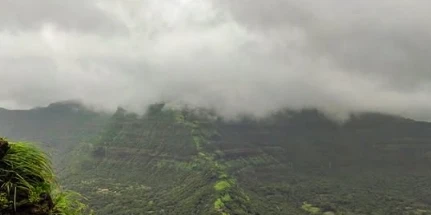
Tikona Fort, also known by the pseudonym Vitandgad Fort, is an ancient Maratha Empire fort built in the 7th or 8th century. Even though nobody is aware of where it originated from, the fort gained strategic importance during the times of the Nizam of Ahmednagar in the early medieval period. It was subsequently captured by the Marathas in the mid-17th century under Chhatrapati Shivaji Maharaj, who realised its significance due to its height and overlooking position over the surrounding area, including the strategic Pawna Maval tract. In 1660, Tikona Fort was added to the expanding chain of Maratha Empire hill forts to gather intelligence, train the army, and administer the area. The fort played an important role in the defense of the Pawna area and protection of the trade routes passing through the Western Ghats. The fort was utilized strategically as a watchtower and supply depot for the nearby forts of Lohagad, Visapur, and Tung. Historic trails and mountain adventures across the Sahyadris are featured in our Treks in Maharashtra guide.Tikona was briefly occupied by the Mughals after the Treaty of Purandar in 1665, when Shivaji had yielded a series of forts. But soon the Marathas recovered it as the Marathas recovered their territories. It fell into the hands of the Peshwas in the 18th century, but later became a strategic anachronism due to the deployment of new techniques of warfare and political realignments that rendered the hill forts anachronistic. Tikona Fort, even now in ruins, carries memories of its glorious past in the shape of bastions, doorways, water tanks, and the Trimbakeshwar Mahadev temple at the top. Both its cultural importance and landscape views make it a much-preferred destination for trekking, as well as an ardent lover of history. Weekend trekkers interested in scenic forts often explore our Tikona Fort Trek Package for a guided experience.Places near Tikona FortPawna Lake: Pawna Lake is a serene artificial lake at a close distance from Tikona Fort. Pawna Dam-designed, this beautiful spot is a camper's, picnic-spender's, and aqua sports enthusiast's paradise, the most sought-after water sports of which are kayaking and boating. Sahyadri hills encircling the vantage points of Tikona, Tung, Lohagad, and Visapur forts encircle this lake. In literal terms, this lake is the ideal spot to relax in nature. Both sunrise and sunset here are merely scenic, and a great add-on activity to the Tikona Fort trek.Tung Fort: Tung Fort or Kathingad is a hill fort located on the other side of Pawna Lake. Its steep climb and narrow path make it a difficult trekking path. The fort is about 3,527 feet above and provides such wide vistas of the Pawna backwaters and the other forts. It was used by the Marathas as a watchtower due to its tapering form and the fact that it's at a raised location.Lohagad Fort: Lohagad Fort, or "Iron Fort," is the most visited hill fort of Maharashtra and lies around 20 km from Tikona. It has a broad plateau at the top, ancient gates, and the celebrated "Vinchu Kata" (scorpion tail-shaped building). The fort was a significant one during Shivaji Maharaj's period and has since become a regular trekking and heritage site to visit, particularly on rainy days.Visapur Fort: Near Lohagad, Visapur Fort is slightly bigger and flatter. It offers a great view of the region and is made up of humongous stone walls, ancient caves, and ancient water cisterns. The fort is usually trekked along with Lohagad since it is nearby and thus is a place for trekkers as well as history enthusiasts.Best Time to Visit Tikona Fort Trek – Seasonal GuideMonsoon Season (June to September): Monsoon time has been defined as one of the best moments to go to Tikona Fort. The entire region is covered with leaves, foggy hills, and meandering streams. The scenery during this time is simply breathtaking, and it's a magical trekking experience. The path might turn slippery due to rain, though, and caution along with suitable trekking footwear needs to be exercised. This is the perfect time for nature enthusiasts and photographers to get the Sahyadris to look their monsoon best.Winter Season (October to February): Winter season is the best and convenient time for the Tikona Fort Trek. The weather is nice and cool, with clear skies, low humidity, and the best time to trek. The path is dry and secure, and the view from the top is magnificent. Trekkers and weekend hikers love this time the most. Early morning and evening are the ideal light and temperature moments for a peaceful trek and photography.Summer Season (March to May): Even in summer, the fort can be climbed, but typically it is not that crowded due to the hot afternoons. Dry heat tires climbers, especially at noon. But if you climb in the early morning, then it is possible. The good point of this season is a minimum crowd and great views, but sunscreen and lots of water should be applied.How to Reach Tikona FortBy Road: Tikona Fort is road accessible and easily accessible from nearby major cities like Pune and Mumbai. From Pune, the fort is approximately 60 km and a 1.5 to 2-hour road drive. The best route is via Paud Road via Pirangut and Mulshi. From Mumbai at a distance of 120 km, it is a 3 to 3.5-hour road drive via the Mumbai-Pune Expressway. Taxi and car are the easiest ways of accessing the base village, Tikona Peth. There is ample parking at the trekking location.By Train: The nearest railway station to Tikona Fort is Lonavala Railway Station, at a distance of 25 km. Lonavala is one of the stopovers on the Mumbai-Pune railway route, and frequent trains run between the two cities. It is possible to hire a taxi or take a local bus to Tikona Peth. Suitable for those taking public transport and willing to walk uphill.By Bus: Regular government transport and private buses operate from Lonavala and Pune to Kamshet and Pawna, nearby towns. You can travel from Kamshet, 20 km from the fort, by shared jeep, auto-rickshaw, or taxi to Tikona Peth. While it is a bit time-consuming, this is an economical mode for solo travellers or backpackers.